
On Citizens And Immigrants
And What It Means To Be A Nation

Estimated Read Time: Medium, About 5 Minutes
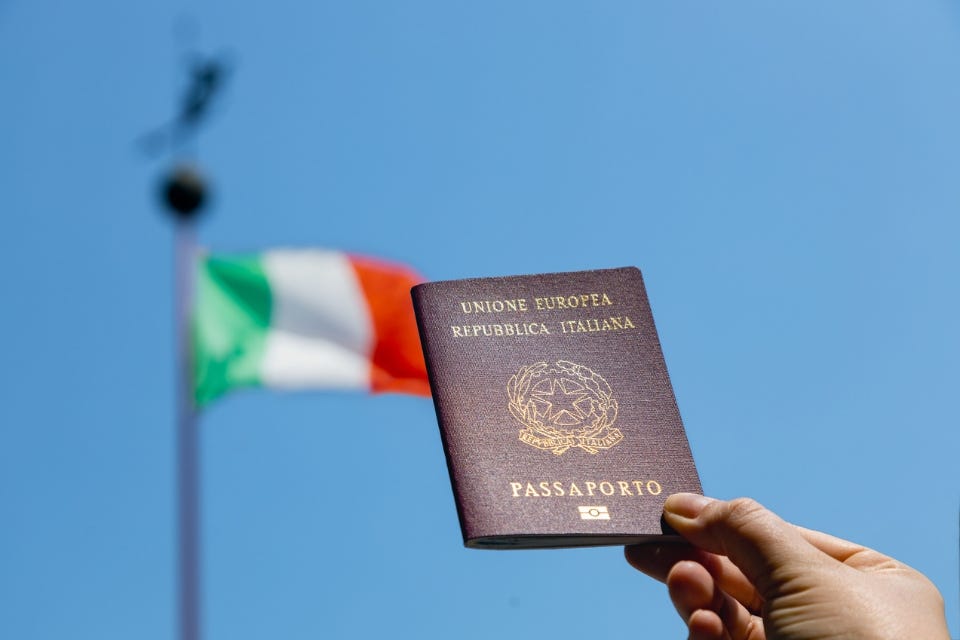
The U.S. Supreme Court is currently hearing legal arguments from the Trump administration on changing the eligibility of naturalized citizens. On March 28th, 2025, Italy changed its laws regarding the naturalization of Italian citizens based on descent, limiting eligibility to applicants with a parent or grandparent born in Italy. Their new law requires applicants to show stronger ties to Italy, limits remote ancestry, and mandates that future applications be centralized in Rome, with many in-person requirements. The law is facing challenges regarding its constitutionality, similar to the Trump administration changes, with appeal hearings set for 2026 which may influence final outcomes. But that begs the question, what is a citizen? And is Italy in the wrong for changing how it defines one?
Soil And Soul Combined
While a nation is a defined plot of land with borders and laws, citizens are the human souls that make a country what it actually is. To understand this practically and not just abstractly, imagine that every American in the U.S. was lifted and placed down in some other place, say, within the borders of Thailand. Simultaneously, imagine every Thai citizen was plucked into the air and placed within the borders of the U.S. Even though the roads, borders, and architecture are unchanged, America would no longer be the same country. Thailand would also no longer be Thailand. The humans within each respective area would fundamentally impact and change the environment within a few days - if not hours. It is therefore obvious and self-evident that a country is not just defined by its geographical borders but by the people who constitute it.
The founding fathers of the U.S. knew this, and they knew that it’s in the self-interest of every nation to ensure that the people within its borders are not just loyal to the homeland, but have the prerogative to adopt the values and culture as well. It’s why new American citizens are sworn to support and defend the U.S. Constitution and laws, bearing true faith and allegiance. While Washington, Hamilton, and Jefferson generally supported immigration and valued its importance for economic growth, the importance of maintaining a cohesive culture was also understood. Language, music, religion, and other cultural aspects make up the foundation of the identity of a nation’s people. When I was in business school, we were taught that the concept that immigrants entering into a new nation were expected to adopt these values was called assimilation. While the teachings of assimilation may have fallen out of favor over the last 15 years, a new framework of thinking about immigration has dominated the mainstream.
“To admit foreigners indiscriminately to the rights of citizens, the moment they put foot in our country, as recommended in the (previous) Message, would be nothing less, than to admit the Grecian Horse into the Citadel of our Liberty and Sovereignty.”
-Alexander Hamilton
“Suppose 20 millions of republican Americans thrown all of a sudden into France, what would be the condition of that kingdom? If it would be more turbulent, less happy, less strong, we may believe that the addition of half a million of foreigners to our present numbers would produce a similar effect here.”
-Thomas Jefferson
The United States is now sparsely referred to as a “melting pot.” Instead, academics and politicians now push for all immigrants to retain their country of origin’s cultural values and ideals. This stems from the post-modern idea that all cultures are equal and deserve to be retained in perpetuity, but this is not only incorrect but dangerous. Some cultures pose a real threat to the stability and safety of western societies. The below video shows three South African men explaining the tactic known as “jack-rolling”, where one man rapes a woman and “rolls” her to the next man. It’s hard to know exactly how frequent these gang rapes occur in South Africa because they are under-reported. When they are, the perpetrators typically receive light punishments. This a great example of a cultural custom that should be excluded from the American diaspora, along with child marriages, animal sacrifice, and other evil acts.
The now famous quip “import the third world, become the third world”, has grown in popularity but lacks the nuance to explain why certain types of immigration have negative effects. I am an immigrant myself, and a healthy influx of new citizenry is vital to the flourishing of any great nation. It’s also possible for a strong nation to retain its “little Italie’s” and its “Chinatowns”, while expecting that the citizens within these neighborhoods uphold a baseline standard of decorum, behavior, and cultural participation. All cultures are not equal, and if we’re smart, we’ll incorporate those of general virtue within our cultural tapestry, and withhold those that degrade it.
Cogs Vs Beings
The fact is that humans are not interchangeable economic units. Many people defend mass migration by claiming that migrants are willing to work jobs that American citizens are unwilling to do. This claim ignores two realities. One is that there are millions of unemployed Americans who would be willing to fill these labor roles, even at the federal minimum wage. The second reality is that these U.S. workers are not hired because profit-focused corporations are happy to violate employment laws and hire illegal immigrants. The hiring of these immigrants naturally drives down the wages that would otherwise be offered to American workers. In other words, it’s not that immigrants are filling a labor market void left by lazy Americans, but rather immigrant workers prevent a labor demand that would otherwise raise wages. Companies like Tyson or General Mills would be forced to increase wages if their access to near slave-level labor was repatriated.
But there’s a third reality that defenders of mass migration don’t talk about. And that’s the fact that supplanting one human within a civilizational system that shares none of its cultural values and ideals fundamentally denies the humanity not just of the immigrant, but of the people who constitute the host country. It’s the equivalent to some politician unlocking your front door and allowing every homeless vagrant to enter your home and raid your fridge. On the other hand, if a homeless man asks to enter politely, and you do a background check, and they behave with fine manners and follow your house rules (no shoes on the carpet!), then by all means they have respected not just your humanity, but their own.
“Manners Maketh Man”
-Bishop William of Wykeham
Forza Italia
While immigration is an important driver of economic growth, there are a handful of things that are more fundamental to society than its annual GDP growth. Individual safety, national security, cultural cohesion, civil tranquility, and institutional trust are prerequisites for peace and prosperity that must come first. When you consider the realities that any nation must contend with, it’s understandable why Italy has recently changed its citizenship laws. The right of a people to self-determination includes the power to determine how their citizenry is obtained and defined. Italy’s new laws were not decreed by a king or dictator, but passed by the majority of the elected legislature and upheld by the courts. I suspect that the U.S. Supreme Court will similarly rule that Congress must act in order to change the naturalization process here. Italy seeks to preserve its sovereignty by making sure the populace retains some form of shared culture, and that doesn’t appear to me to be a bad thing.