
How ‘Disparate Impact’ Punishes The Innocent
Outcome Equity Has Failed. It’s Time to Re-Embrace Equality of Opportunity

Read Time: Medium - about 5 minutes
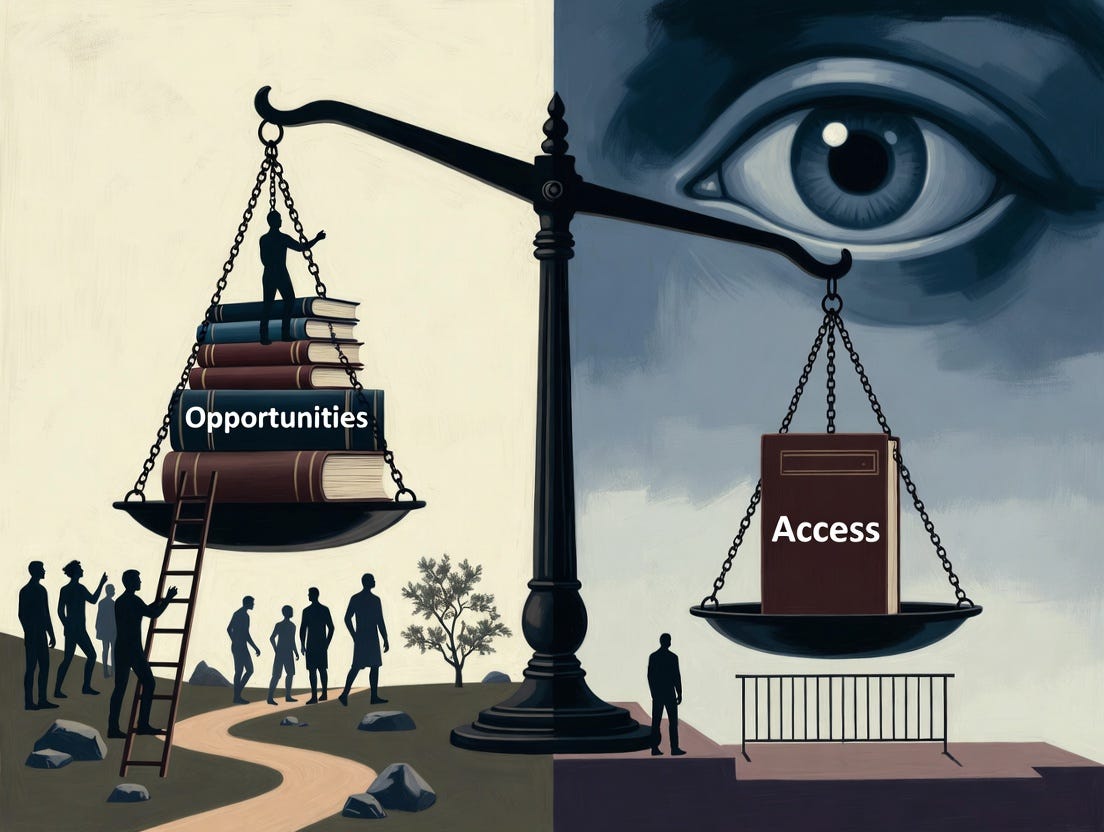
A real estate company tried to make rational business decisions.
It followed neutral standards.
It didn’t use race in its criteria.
It still paid a hefty price.
The most serious defense of disparate impact is not that intent is irrelevant, but that intent is often impossible to prove. Discrimination, its defenders argue, has evolved. It is rarely explicit. It is embedded in systems, incentives, and inherited social conditions. If the law requires proof of animus, then sophisticated discrimination will simply operate through neutral rules that replicate inequality. Statistical disparities, in this view, are evidence of hidden barriers. The burden must therefore shift to institutions to justify policies that produce unequal outcomes.
This argument has surface level appeal, but it rests on a critical assumption: that unequal outcomes are reliable evidence of injustice. In a heterogeneous society, that assumption is fragile. Groups differ in geography, age distribution, educational background, preferences, and risk tolerance. Equal rules do not guarantee equal results. A disparity, by itself, cannot identify which variable is causal. When statistical imbalance becomes presumptive proof of wrongdoing, the law moves from prohibiting discrimination to mandating demographic calibration. Originally a policy that was seemingly justified as a way to combat racist money lenders and employers, I believe ‘disparate impact’ has subsequently proven to be ineffective and immoral.
“In no society have all regions and all parts of the population developed equally.” -Fernand Braudel
Erosion of Individual Agency
For starters, it’s immoral to hold an individual or company responsible for broad societal outcomes they did not cause. If a business makes a decision based on objective metrics (like profitability), punishing them for the “effect” treats them as a scapegoat for historical issues beyond their control. Just as Western Judeo-Christian values forbid punishing sons for the sins of their fathers, we should not punish people today for the sins of their forbearers.
Mandatory Racial Engineering
The flip side of disparate impact policies is that in order to avoid lawsuits, companies often feel forced to adopt racial quotas in order to have minority representation that is satisfactory to the EEOC. Some critics have called this “reverse discrimination”, but in reality it is just plain discrimination against people who would otherwise have earned their places within organizations through merit. This clearly violates the principle of colorblindness, and ironically makes race a primary factor in decisions where it shouldn’t belong.
Economic Inefficiency
By making it legally risky to use neutral standards (like credit scores, home prices, or criminal records), the doctrine can force businesses to accept extremely high levels of risk. This can lead to higher costs for everyone or the withdrawal of services from certain markets altogether to avoid legal liability or bankruptcy. Podcaster Matt Walsh pointed out a recent example of this occurring in a recent episode.
“A couple of years ago Redfin was sued in federal court for supposedly being a racist company that discriminated against blacks. Redfin was accused of redlining, which in this case meant that they wouldn’t offer some of their most expensive services to very cheap homes. It wasn’t profitable enough for them to offer say, professional photography and in-home tours for a dilapidated shack in the hood that was listed for $70,000. There was nothing racist about Redfin’s decision making, it makes a lot of sense. But because their rational business decision had a ‘disparate or disproportionate’ impact on black people (since black people tended to own those kinds of homes in that area), Redfin had to settle the case and agree to provide these services to more people even if it went against their economic interests to do so.” -Matt Walsh Show ep. 1732
The “Correlation vs. Causation” Fallacy
Disparate impact assumes that a statistical imbalance is proof of a “barrier”. This is illegitimate because it ignores other variables like geography, culture, education, and age, which typically more accurately explain disparities rather than systemic bias. A great example would be the nursing industry, which is largely dominated by women. The schools, hospitals, and doctors offices who educate, train, and hire these women are not directly seeking to harm men; they are simply dealing with the reality that most people who want to be nurses are female. Notably, while we often hear of campaigns to recruit more women to engineering or senior leadership positions, we never hear calls to recruit more men to nursing or social work. We also don’t see advocacy for placing more women in dangerous or isolating careers such as oil rig operations, electrical line repair, or long-haul trucking - jobs that pay well and would help the progressive left in eliminating the difference in pay between the sexes. Thus we see the doctrine is applied selectively. If disparity alone were evidence of injustice, it would be pursued consistently across industries. It is evident that the application is only ever used to selectively pursue equity on behalf of certain demographics, and not others, which is an inequality in and of itself.
Violation of Due Process
In our legal system, you are “innocent until proven guilty” of a specific act. Disparate impact flips this, often requiring a company to prove its innocence by showing a “business necessity” for a neutral policy simply because the numbers don’t look perfectly balanced. This flagrant inversion of the legal principles our country was founded on should be enough for most people to oppose the enforcement and application of these policies.
Overruled
In a 6-3 decision on June 29, 2023, the U.S. Supreme Court effectively ended race-based affirmative action programs in college admissions, ruling they violated the Equal Protection Clause of the Fourteenth Amendment. The majority held that the Constitution permits no superior, dominant, or ruling class of citizens, and that admissions must be based on an individual’s experience, not on the basis of race.
If equality of opportunity means anything, it cannot mean punishing people for outcomes they did not engineer. Let’s hope ‘disparate impact’ meets a similar fate.
This opinion is an effort to create a civilized discourse. If you support this mission, please subscribe - even for free. It really helps me out.
If you are particularly interested in this topic, I highly recommend Thomas Sowell’s 2018 book Discrimination and Disparities.